<?xml version="1.0" encoding="ISO-8859-1"?><article xmlns:mml="http://www.w3.org/1998/Math/MathML" xmlns:xlink="http://www.w3.org/1999/xlink" xmlns:xsi="http://www.w3.org/2001/XMLSchema-instance">
<front>
<journal-meta>
<journal-id>0004-0525</journal-id>
<journal-title><![CDATA[Archivos Bolivianos de Medicina ]]></journal-title>
<abbrev-journal-title><![CDATA[Arch.Boliv.Med.]]></abbrev-journal-title>
<issn>0004-0525</issn>
<publisher>
<publisher-name><![CDATA[Facultad de Medicina de la universidad Mayor, Real y Pontificia de San Francisco Xavier de Chuquisaca.]]></publisher-name>
</publisher>
</journal-meta>
<article-meta>
<article-id>S0004-05252018000100003</article-id>
<title-group>
<article-title xml:lang="es"><![CDATA[DEPENDENCY, RISK OF ADDICTION TO THE USE OF THE CELLULAR IN MEDICINE STUDENTS AT SAN FRANCISCO XAVIER UNIVERSITY. SUCRE. 2017]]></article-title>
<article-title xml:lang="en"><![CDATA[Dependencia, riesgo de Adicción al Uso del Celular en estudiantes de Medicina en la Universidad San Francisco Xavier, Sucre, 2017]]></article-title>
</title-group>
<contrib-group>
<contrib contrib-type="author">
<name>
<surname><![CDATA[Alcoba Heredia]]></surname>
<given-names><![CDATA[P.]]></given-names>
</name>
<xref ref-type="aff" rid="A01"/>
</contrib>
<contrib contrib-type="author">
<name>
<surname><![CDATA[Choqueticlla Condori]]></surname>
<given-names><![CDATA[A.]]></given-names>
</name>
<xref ref-type="aff" rid="A01"/>
</contrib>
<contrib contrib-type="author">
<name>
<surname><![CDATA[Condori Zárate]]></surname>
<given-names><![CDATA[Y. M.]]></given-names>
</name>
<xref ref-type="aff" rid="A01"/>
</contrib>
<contrib contrib-type="author">
<name>
<surname><![CDATA[Quiroga Ramos]]></surname>
<given-names><![CDATA[J. M.]]></given-names>
</name>
<xref ref-type="aff" rid="A01"/>
</contrib>
<contrib contrib-type="author">
<name>
<surname><![CDATA[Villalba Yevara]]></surname>
<given-names><![CDATA[J.B.]]></given-names>
</name>
<xref ref-type="aff" rid="A01"/>
</contrib>
</contrib-group>
<aff id="A01">
<institution><![CDATA[,Universidad Mayor, Real y Pontificia de San Francisco Xavier de Chuquisaca  ]]></institution>
<addr-line><![CDATA[ ]]></addr-line>
</aff>
<pub-date pub-type="pub">
<day>00</day>
<month>06</month>
<year>2018</year>
</pub-date>
<pub-date pub-type="epub">
<day>00</day>
<month>06</month>
<year>2018</year>
</pub-date>
<volume>29</volume>
<numero>97</numero>
<fpage>16</fpage>
<lpage>25</lpage>
<copyright-statement/>
<copyright-year/>
<self-uri xlink:href="http://www.scielo.br/scielo.php?script=sci_arttext&amp;pid=S0004-05252018000100003&amp;lng=en&amp;nrm=iso&amp;tlng=en"></self-uri><self-uri xlink:href="http://www.scielo.br/scielo.php?script=sci_abstract&amp;pid=S0004-05252018000100003&amp;lng=en&amp;nrm=iso&amp;tlng=en"></self-uri><self-uri xlink:href="http://www.scielo.br/scielo.php?script=sci_pdf&amp;pid=S0004-05252018000100003&amp;lng=en&amp;nrm=iso&amp;tlng=en"></self-uri><abstract abstract-type="short" xml:lang="en"><p><![CDATA[ABSTRACT The present research was carried out with the purpose of identifying the dependence and risk of addiction to the mobile phone in Medicine students at San Francisco Xavier University. The selected approach used in the research was quantitative with a descriptive method of multidisciplinary type, taking into account a population of 345 surveyed students based on the levels of study they are, as well as their gen-der. As we show in the results, the time of use greaterthan three hours, prevails more in wom-en than in men, which faces a possible risk of addiction. Concluding that, this differential prev-alence between genders occurs more in women because of reasons of low self-esteem and / or social approval, while men are oriented towards the use of applications by means of distraction and overcoming.]]></p></abstract>
<abstract abstract-type="short" xml:lang="es"><p><![CDATA[RESUMEN La presente investigación se realizó con el objetivo de identificar la dependencia y el riesgo de adicción al teléfono móvil en estudiantes de Medicina de la Universidad San Francisco Xavier. El enfoque seleccionado utilizado en la investigación fue cuantitativo con un método descriptivo de tipo multidisciplinario, teniendo en cuenta una población de 345 estudiantes encuestados en función de los niveles de estudio que son, así como su género. Como mostramos en los resultados, el tiempo de uso mayor a tres horas, prevalece más en mujeres que en hombres, lo que enfrenta un posible riesgo de adicción. Concluyendo que, esta prevalencia diferencial entre géneros ocurre más en mujeres por razones de baja autoestima y / o aprobación social, mientras que los hombres se orientan hacia el uso de aplicaciones mediante la distracción y la superación.]]></p></abstract>
<kwd-group>
<kwd lng="en"><![CDATA[Dependency]]></kwd>
<kwd lng="en"><![CDATA[addiction]]></kwd>
<kwd lng="en"><![CDATA[mobile phone]]></kwd>
<kwd lng="en"><![CDATA[applications]]></kwd>
<kwd lng="en"><![CDATA[nomophobia]]></kwd>
<kwd lng="en"><![CDATA[phubbing]]></kwd>
<kwd lng="es"><![CDATA[Dependencia]]></kwd>
<kwd lng="es"><![CDATA[adicción]]></kwd>
<kwd lng="es"><![CDATA[teléfono móvil]]></kwd>
<kwd lng="es"><![CDATA[aplicaciones]]></kwd>
<kwd lng="es"><![CDATA[nomofobia]]></kwd>
<kwd lng="es"><![CDATA[phubbing]]></kwd>
</kwd-group>
</article-meta>
</front><body><![CDATA[ <p align="right"><font face="Verdana, Arial, Helvetica, sans-serif" size="2"><b>ARTÍCULO ORIGINAL</b></font></p>     <p align="justify">&nbsp;</p>     <p align="center"><font face="Verdana, Arial, Helvetica, sans-serif" size="2"><b><font size="4">DEPENDENCY, RISK OF ADDICTION TO THE USE OF THE CELLULAR IN MEDICINE STUDENTS AT SAN FRANCISCO XAVIER UNIVERSITY. SUCRE. 2017</font></b></font></p>     <p align="center">&nbsp;</p>     <p align="center"><font face="Verdana, Arial, Helvetica, sans-serif" size="3"><b>Dependencia, riesgo de Adicción al Uso del Celular en estudiantes de Medicina en la Universidad San Francisco Xavier, Sucre, 2017</b></font></p>     <p align="center">&nbsp;</p>     <p align="center">&nbsp;</p>     <p align="center"><font face="Verdana, Arial, Helvetica, sans-serif" size="2"><b>1    Alcoba Heredia P. Choqueticlla Condori A. Condori Z&aacute;rate Y. M. Quiroga Ramos J. M. Villalba Yevara J.B.</b></font><font face="Verdana" size="2">    <br> </font><font face="Verdana, Arial, Helvetica, sans-serif" size="2">1     Universidad Mayor, Real y Pontificia de San Francisco Xavier de Chuquisaca. Second Course of Medicine College.</font><font face="Verdana" size="2">    <br></font><font face="Verdana, Arial, Helvetica, sans-serif" size="2"><b>Recepci&oacute;n</b>: 15 de octubre 2017 <b>Aceptado</b>: 10 de diciembre de 2017</font></p>     ]]></body>
<body><![CDATA[<p align="justify">&nbsp;</p>     <p align="justify">&nbsp;</p> <hr>     <p align="justify"><font face="Verdana, Arial, Helvetica, sans-serif" size="2"><b>ABSTRACT</b></font></p>     <p align="justify"><font face="Verdana, Arial, Helvetica, sans-serif" size="2">The present research was carried out with the purpose of identifying the dependence and risk of addiction to the mobile phone in Medicine students at San Francisco Xavier University. The selected approach used in the research was quantitative with a descriptive method of multidisciplinary type, taking into account a population of 345 surveyed students based on the levels of study they are, as well as their gen-der. As we show in the results, the time of use greaterthan three hours, prevails more in wom-en than in men, which faces a possible risk of addiction. Concluding that, this differential prev-alence between genders occurs more in women because of reasons of low self-esteem and / or social approval, while men are oriented towards the use of applications by means of distraction and overcoming.</font></p>     <p align="justify"><font face="Verdana, Arial, Helvetica, sans-serif" size="2"><b>KEYWORDS:</b></font></p>     <p align="justify"><font face="Verdana, Arial, Helvetica, sans-serif" size="2">Dependency, addiction, mobile phone, applications, nomophobia, phubbing</font></p> <hr>     <p align="justify"><font face="Verdana, Arial, Helvetica, sans-serif" size="2"><b>RESUMEN</b></font></p>     <p align="justify"><font face="Verdana, Arial, Helvetica, sans-serif" size="2">La presente investigación se realizó con el objetivo de identificar la dependencia y el riesgo de adicción al teléfono móvil en estudiantes de Medicina de la Universidad San Francisco Xavier. El enfoque seleccionado utilizado en la investigación fue cuantitativo con un método descriptivo de tipo multidisciplinario, teniendo en cuenta una población de 345 estudiantes encuestados en función de los niveles de estudio que son, así como su género. Como mostramos en los resultados, el tiempo de uso mayor a tres horas, prevalece más en mujeres que en hombres, lo que enfrenta un posible riesgo de adicción. Concluyendo que, esta prevalencia diferencial entre géneros ocurre más en mujeres por razones de baja autoestima y / o aprobación social, mientras que los hombres se orientan hacia el uso de aplicaciones mediante la distracción y la superación.</font></p>     <p align="justify"><font face="Verdana, Arial, Helvetica, sans-serif" size="2"><b>PALABRAS CLAVE: </b></font></p>     <p align="justify"><font face="Verdana, Arial, Helvetica, sans-serif" size="2">Dependencia, adicción, teléfono móvil, aplicaciones, nomofobia, phubbing</font></p> <hr>     ]]></body>
<body><![CDATA[<p align="justify">&nbsp;</p>     <p align="justify">&nbsp;</p>     <p align="justify"><font face="Verdana, Arial, Helvetica, sans-serif" size="2"><b><font size="3">INTRODUCTION</font></b></font></p>     <p align="justify"><font face="Verdana, Arial, Helvetica, sans-serif" size="2">The emergence of new mobile technologies has facilitated communication between the global population, but it also has generated changes at all levels of coexistence in society. The new emerging social context, the use and development of these new technologies by the youngest, imply new potentials for their growth, development, autonomy and personal training, but it also brings associated risks (1). And those who are most affected, positively or negatively, are those who were born at the time of their implementation in society, as well as later generations who live adapted to the new technological environment (2).</font></p>     <p align="justify"><font face="Verdana, Arial, Helvetica, sans-serif" size="2">Cell phones are already part of teenagers' anatomy, representing a Utopia, affecting their academic performance, family breakdown, obtaining physical and psychological damage (3).</font></p>     <p align="justify"><font face="Verdana, Arial, Helvetica, sans-serif" size="2">There is talk of non-conventional addictions, also called behavioural or technological addictions that include the Internet, cell phones, video games and any technological device, always that their use is dependent, unjustified and excessive; they also involve the human-machine interaction, and are divided between passive (such as television) and active (such as Internet, cellularand videogames) (4). For this reason the present research was in need of further deepening this issue, seeing the use and applicability that is currently given, it proposes to define the limits of dependence and addiction  in</font></p>     <p align="justify"><font face="Verdana, Arial, Helvetica, sans-serif" size="2">the University students at Medicine College of San Francisco Xavier University of Chuquisaca.</font></p>     <p align="justify"><font face="Verdana, Arial, Helvetica, sans-serif" size="2"><b>BACKGROUND</b></font></p>     <p align="justify"><font face="Verdana, Arial, Helvetica, sans-serif" size="2">Cellular telephony and Internet emerged in parallel as a result of an intense search to improve interpersonal communication, it began at the beginning of the 70s with the only thought of benefiting large government sectors and private companies, however, both technologies exceeded their limits.</font></p>     <p align="justify"><font face="Verdana, Arial, Helvetica, sans-serif" size="2">Takao, takahashi and kitamura (2009) state that at least 70% of the Japanese population, 62% of users in the United States and 81% of people in Australia, use mobile phones in 2005 showing high use (5).</font></p>     ]]></body>
<body><![CDATA[<p align="justify"><font face="Verdana, Arial, Helvetica, sans-serif" size="2">Studies conducted in the United Kindom in 2011, with a sample of 2163 people, revealed that almost 53% of users tend to feel anxiety when they lose their mobile phone, they run out of battery or credit, or they do not have coverage, in accordance with the study about 58% of men and 48% of women suffer from nomophobia (6).</font></p>     <p align="justify"><font face="Verdana, Arial, Helvetica, sans-serif" size="2">According to a study conducted by Rastreador.com, more than half of the population (56%) actively uses the mobile device for at least 3 hours per day, the average usage being 4.24 hours daily, 24 minutes, more than the previous year. The users with a more active profile are the youngest between 18 and 24 years old, where the hours amount to 6.8 hours in contrast to the older ones who use it in a 3 hours daily. Furthermore, in terms of gender, women use an average of 42 minutes more than men. (7)</font></p>     <p align="justify"><font face="Verdana, Arial, Helvetica, sans-serif" size="2">We worked with a sample of 1400 university students, 1044 of which came from the National San Agustín University (Public) and 356 from the San Pablo Catholic University (Private). With regard to sex, women had higherscoresthan men and students from private universities had higher scores than students from public universities (8).</font></p>     <p align="justify"><font face="Verdana, Arial, Helvetica, sans-serif" size="2">With regard to technological addictions, cell addiction was first elaborated by Morales (2012) using a sample of 1253 students from a private university in Arequipa, and found that 8.1% of women and 3.4% of males present symptoms of cell addiction (9).</font></p>     <p align="justify"><font face="Verdana, Arial, Helvetica, sans-serif" size="2">In January 2016, the Adimark company, togetherwith Entel, carried out a study to detect the nomophobia in Chile. They revealed that 64% of respondents believe that the cell phone is more important than a computer or television. In this universe, women prioritize it the</font></p>     <p align="justify"><font face="Verdana, Arial, Helvetica, sans-serif" size="2">most with 76% of responses vs. 53% of men. Another of the data reported by the survey is that half of the sample prefers to forget the keys at home before the phone, so it is not surprising that a majority 60% assures that they would be returned to look for it (10). The study Cultura y Violencia Digital in Cochabamba, prepared by Fundación Redes reveals that eight out of ten teenagers in the city of Cochabamba - Bolivia declare themselves addicted to mobile phones and do not mind being in that condition. The president of that organization Eduardo Rojas, explained that during the 2016 management a study was developed on the use of cell phones between 700 adolescents. &quot;We have just finished the study and there it is revealed that 80% of adolescents under the age of 18 who are of school age declare themselves addicted,&quot; he said (11).</font></p>     <p align="justify">&nbsp;</p>     <p align="justify"><font face="Verdana, Arial, Helvetica, sans-serif" size="2"><b><font size="3">PROBLEM FORMULATION</font></b></font></p>     <p align="justify"><font face="Verdana, Arial, Helvetica, sans-serif" size="2">What is the dependency and risk of addiction to the use of mobile phones in students of Medicine College at San Francisco Xavier University, Sucre, 2017?</font></p>     <p align="justify">&nbsp;</p>     ]]></body>
<body><![CDATA[<p align="justify"><font face="Verdana, Arial, Helvetica, sans-serif" size="2"><b><font size="3">OBJECTIVE</font></b></font></p>     <p align="justify"><font face="Verdana, Arial, Helvetica, sans-serif" size="2">Identify the dependence and risk of addiction to cell phone use in medicine students at San Francisco Xavier University, Sucre, 2017.</font></p>     <p align="justify"><font face="Verdana, Arial, Helvetica, sans-serif" size="2">For the study we will define the following words:</font></p>     <p align="justify"><font face="Verdana, Arial, Helvetica, sans-serif" size="2"><b>1.- Mobile phone: </b>The mobile phone or cell phone is a very useful tool for easy communication and it currently has many applications that the individual can use in their daily activities and professional tasks. Nowadays, with the possibilities of mobility, the smartphone has become practically a computer and increasingly, a medium that supports other means. It has been adopted on a large scale and it is already part of the social landscape of many countries. It satisfies several human needs, such as communicating in movement, speaking and walking at the same time (12).</font></p>     <p align="justify"><font face="Verdana, Arial, Helvetica, sans-serif" size="2"><b>2.- Applications: </b>These are softwares that run on smartphones or other mobile communication devices and that are usually distributed on digital platforms or generated by people or organizations through Software Engineering. Mobile applications (Apps) are part of this group of tools and have become the favourite way for users to connect from their devices. The specific characteristics of each mobile application are associated with the necessary requirements for</font></p>     <p align="justify"><font face="Verdana, Arial, Helvetica, sans-serif" size="2">the effective provision of the services for which it was designed (13).</font></p>     <p align="justify"><font face="Verdana, Arial, Helvetica, sans-serif" size="2"><b>3.- Dependence: </b>It is the uncontrollable desire to consume something or perform some activity, generating dissatisfaction if a need is not met, causing the individual to experience unpleasant feelings or anxiety while the addiction completely commits the will, considered a psychic disorder (14).</font></p>     <p align="justify"><font face="Verdana, Arial, Helvetica, sans-serif" size="2"><b>4.- Addiction: </b>Addiction is the greatest risk of excessive use of new technologies, generates addictive behavior that leads not only to excessive dedication (which can be removed from other types of healthier activities and very necessary at certain ages), but to a true dependence and lack of control over their behavior. This addiction is more likely to be generated in the adolescentthan in the adult (15).</font></p>     <p align="justify"><font face="Verdana, Arial, Helvetica, sans-serif" size="2"><b>5.- Nomophobia: </b>Irrational fear of losing your cell phone or leaving it at home. It is also due to consult messages frequently. The symptoms presented are: anxiety, tachycardia, obsessive thoughts, headache and stomachache.</font></p>     <p align="justify"><font face="Verdana, Arial, Helvetica, sans-serif" size="2">And its causes can occur because of problems of self-esteem and relationship, as well as personal insecurity, seeking perfectionism, reaching to an absolute slavery to the mobile, getting to the addiction be uncontrollable. As a consequence, it is people who cannot turn off their cell phone at night, interrupting their sleep hours, therefore, a clearsign of insomnia is frequent in nomophobic patients. (16)</font></p>     ]]></body>
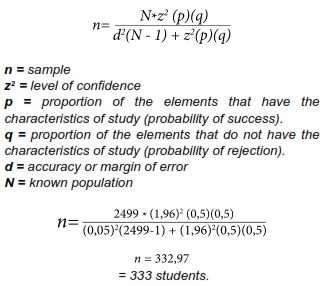
<body><![CDATA[<p align="justify"><font face="Verdana, Arial, Helvetica, sans-serif" size="2"><b>6.- Phubbing: </b>It is the sick action of paying all the attention to the cell phone or other mobile device just to be aware of what happens in social networks. This pathology was born with the arrival of the smart phone, phubbing consists of the act of belittling the person who accompanies oneself by paying more attention to the telephone or other electronic devices than to oneself.</font></p>     <p align="justify"><font face="Verdana, Arial, Helvetica, sans-serif" size="2">Many people preferto make textual conversations in a family dinner, than to do it in person, that is considered a discourteous habit of attention (17).</font></p>     <p align="justify">&nbsp;</p>     <p align="justify"><font face="Verdana, Arial, Helvetica, sans-serif" size="2"><b><font size="3">MATERIALS AND METHODS</font></b></font></p>     <p align="justify"><font face="Verdana, Arial, Helvetica, sans-serif" size="2">The present work has a quantitative approach, the type of study is observational, with a level of descriptive analysis and a muitidisciplinary directionality.</font></p>     <p align="justify"><font face="Verdana, Arial, Helvetica, sans-serif" size="2">The research will be conducted in students from 1st to 5th year of study, of the Medicine College of San Francisco Xavier University of Chuquisaca. Being a total of 2499 students.</font></p>     <p align="justify"><font face="Verdana, Arial, Helvetica, sans-serif" size="2">The sample to be used will be of probabilistic type, (stratified and systematic), based on the number of students from the 1 st to the 5th year and its distribution by grades, also differentiating the dependence and / or risk of addiction that they would present according to their study year of study.</font></p>     <p align="justify"><font face="Verdana, Arial, Helvetica, sans-serif" size="2">According to the following formula (for quantitative</font></p>     <p align="center"><img src="/img/revistas/abm/v29n97/a03_figura01.jpg" width="328" height="286"></p>     <p align="justify">&nbsp;</p>     ]]></body>
<body><![CDATA[<p align="justify"><font face="Verdana, Arial, Helvetica, sans-serif" size="2">The population or universe to be studied in the present research are the students from 1st to 5th year of study, from Medicine College at San Francisco Xavier University of Chuquisaca, specially the students of the area of Public Health, that has 2499 students distributed in all the managements, related to the subject.</font></p>     <p align="justify"><font face="Verdana, Arial, Helvetica, sans-serif" size="2">Inclusion criteria will be considered forthose students who are enrolled in the 1st to 5th year of study, of the Medicine College, who are enrolled and regularly attend theoretical classes in the area of Public Health. Students who do not attend classes, who are repeating, who have abandoned the academic year, who are not at the time of data collection or who belong to other faculties will be excluded.</font></p>     <p align="justify"><font face="Verdana, Arial, Helvetica, sans-serif" size="2">Regarding the primary sources for the collection of information, the students of the Medicine College will be taken into account and a prepared and written survey (Questionnaire with direct and indirect questions) will have to be used as a collection instrument for the necessary information. And as a secondary source we used data from the internet website, magazines, dictionaries and related articles.</font></p>     <p align="justify"><font face="Verdana, Arial, Helvetica, sans-serif" size="2">the authors and the tutor. Special authorization will be provided if required, to the Medicine College for the management of the results. The participation of the students will be voluntary; in addition doubts that could arise at the time of conducting the survey will be clarified.</font></p>     <p align="justify"><font face="Verdana, Arial, Helvetica, sans-serif" size="2">Concerning the pilot tests carried out before the information was collected, they had a favorable acceptance.</font></p>     <p align="justify"><font face="Verdana, Arial, Helvetica, sans-serif" size="2">For the processing of the collected data and for the elaboration of the graphs, Microsoft Excel, Microsoft Word and Epi info 7 programs will be used. As for the data analysis plan, the work begins with the data collection through the surveys, because the work is quantitative and reliable for the development of statistics. Based on the reading and counting the surveys carried out, we will proceed to its representation and interpretation with programs such as Excel by making various tables or graphs.</font></p>     <p align="justify"><font face="Verdana, Arial, Helvetica, sans-serif" size="2">And finally the survey to be conducted will be done anonymously, respecting the identity of the subject surveyed and the information will be used strictly for research purposes and will be handled specifically by</font></p>     <p align="justify">&nbsp;</p>     <p align="justify"><font face="Verdana, Arial, Helvetica, sans-serif" size="2"><b><font size="3">RESULTS</font></b></font></p>     <p align="justify"><font face="Verdana, Arial, Helvetica, sans-serif" size="2">The present work was planned to be carried out with 333 students from the first to the fifth year of the Public Health area of the Medicine College at San Francisco Xavier University of Chuquisaca, however 345 students were interviewed.</font></p>     ]]></body>
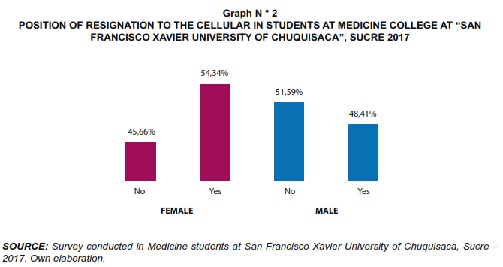
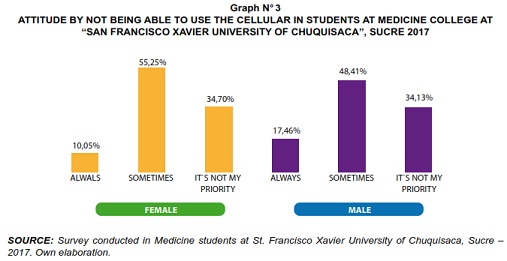
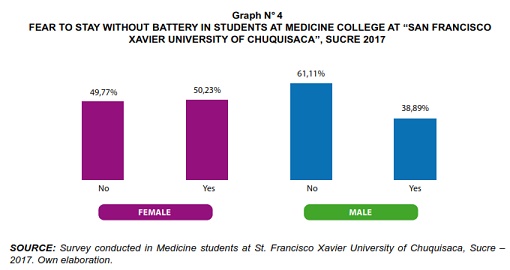
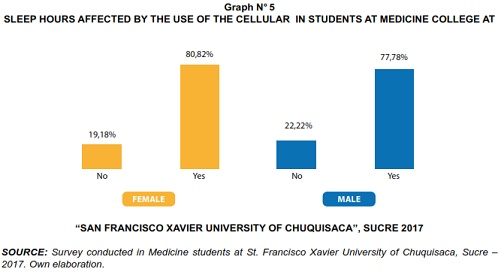
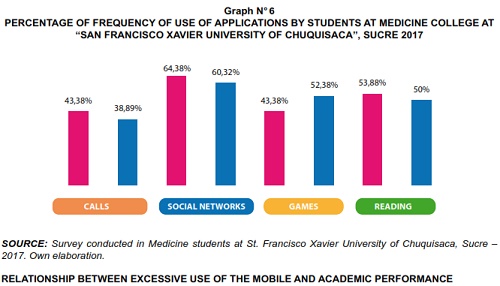
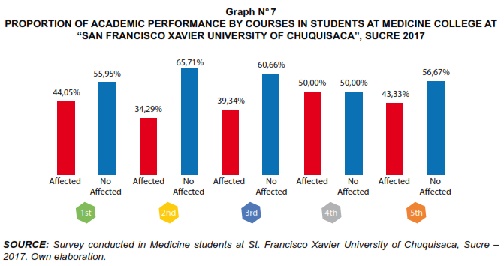
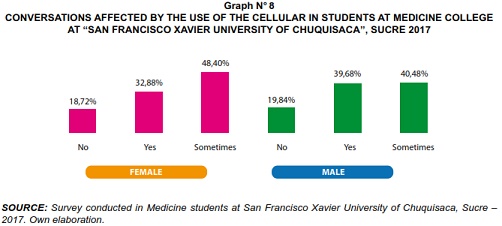
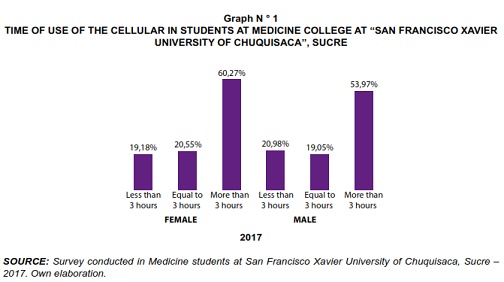
<body><![CDATA[<p align="justify"><font face="Verdana, Arial, Helvetica, sans-serif" size="2">It is observed that those people who report an excessive use of mobile phones experience significant anxiety compared to those who do not tend to make excessive use of them. Besides that this excessive use prevails more in women than in men, being the main cause as social approval and self-esteem, while men are more oriented with the use of applications and games, as a means of distraction and improvement. And finally it is established that there is a close relationship between the excessive use of mobile and academic performance.</font></p>     <p align="center"><img src="/img/revistas/abm/v29n97/a03_grafico01.jpg" width="504" height="282"></p>     <p align="center">&nbsp;</p>     <p align="center"><img src="/img/revistas/abm/v29n97/a03_grafico02.jpg" width="503" height="267"></p>     <p align="justify">&nbsp;</p>     <p align="center"><img src="/img/revistas/abm/v29n97/a03_grafico03.jpg" width="507" height="261"></p>     <p align="justify">&nbsp;</p>     <p align="center"><img src="/img/revistas/abm/v29n97/a03_grafico04.jpg" width="510" height="270"></p>     <p align="justify">&nbsp;</p>     <p align="center"><img src="/img/revistas/abm/v29n97/a03_grafico05.jpg" width="501" height="275"></p>     ]]></body>
<body><![CDATA[<p align="justify">&nbsp;</p>     <p align="center"><img src="/img/revistas/abm/v29n97/a03_grafico06.jpg" width="500" height="286"></p>     <p align="justify">&nbsp;</p>     <p align="center"><img src="/img/revistas/abm/v29n97/a03_grafico07.jpg" width="504" height="266"></p>     <p align="justify">&nbsp;</p>     <p align="center"><img src="/img/revistas/abm/v29n97/a03_grafico08.jpg" width="502" height="226"></p>     <p align="justify">&nbsp;</p>     <p align="justify"><font face="Verdana, Arial, Helvetica, sans-serif" size="3"><b>CONCLUSIONS</b></font></p>     <p align="justify"><font face="Verdana, Arial, Helvetica, sans-serif" size="2">Based on the results, the proposed hypothesis was confirmed:</font></p>     <p align="justify"><font face="Verdana, Arial, Helvetica, sans-serif" size="2">-&nbsp; &nbsp;People who report an excessive use of mobile phones experience significant anxiety compared to thosewhodo nottend to make excessive use ofthem. Using the following questions of the survey:</font></p>     ]]></body>
<body><![CDATA[<p align="justify"><font face="Verdana, Arial, Helvetica, sans-serif" size="2">&#9658;&nbsp; &nbsp; <i>How long do you use your cell phone during the day?</i></font></p>     <p align="justify"><font face="Verdana, Arial, Helvetica, sans-serif" size="2">&#9658;&nbsp; &nbsp;<i>If I do not have a connection to the Network (either through data or Wi-Fi), do I constantly check if there is any signal nearby to connect to or try to find it?</i></font></p>     <p align="justify"><font face="Verdana, Arial, Helvetica, sans-serif" size="2">&#9658;&nbsp; &nbsp;<i>If I am talking to a person and I receive an SMS, do I ignore it so that I do not lose the attention ofthe conversation?</i></font></p>     <p align="justify"><font face="Verdana, Arial, Helvetica, sans-serif" size="2">&#9658;&nbsp; &nbsp; <i>Does the idea of running out of my cell phone scares me?</i></font></p>     <p align="justify"><font face="Verdana, Arial, Helvetica, sans-serif" size="2">&#9658;&nbsp; &nbsp; <i>Does it bother me not being able to use my phone and its applications when I want to do it?</i></font></p>     <p align="justify"><font face="Verdana, Arial, Helvetica, sans-serif" size="2">&#9658;&nbsp; &nbsp; <i>Emotionally, would it be very difficult for me to give up using my mobile?</i></font></p>     <p align="justify"><font face="Verdana, Arial, Helvetica, sans-serif" size="2"><i>-&nbsp;</i>There is the prevalence of excessive use of mobile phones more in women than in men, due to low self-esteem and / or social approval, compared to men it would be more because ofthe use of applications as a mean of distraction and improvement.</font></p>     <p align="justify"><font face="Verdana, Arial, Helvetica, sans-serif" size="2">It was confirmed that women use more cell phones in accessing social networks and reading and men in social networks and games (Graph N&deg;7). Taking into account that women carry the highest percentages in the use of the cell shown through the answers obtained in the surveys, in the question:</font></p>     <p align="justify"><font face="Verdana, Arial, Helvetica, sans-serif" size="2"><i>What is the main purpose to use your cell phone?</i></font></p>     <p align="justify"><font face="Verdana, Arial, Helvetica, sans-serif" size="2"><i>- </i>There is a close relationship between excessive use of the mobile phone and academic performance in students at Medicine College. According to the following questions:</font></p>     ]]></body>
<body><![CDATA[<p align="justify"><font face="Verdana, Arial, Helvetica, sans-serif" size="2">&#9658;   <i>Didthe use of your mobile affect your academic performance?</i></font></p>     <p align="justify"><font face="Verdana, Arial, Helvetica, sans-serif" size="2"><i>How long do you spend using your cell phone during the day?</i></font></p>     <p align="justify"><font face="Verdana, Arial, Helvetica, sans-serif" size="2"><i>Didthe use of your mobile affect your academic performance?</i></font></p>     <p align="justify"><font face="Verdana, Arial, Helvetica, sans-serif" size="2"><i>Does the time I dedicate to my mobile prevents me from doing important tasks?</i></font></p>     <p align="justify"><font face="Verdana, Arial, Helvetica, sans-serif" size="2"><b>Dependence and addiction</b></font></p>     <p align="justify"><font face="Verdana, Arial, Helvetica, sans-serif" size="2">As we have realized, students at San Francisco Xavier University of Chuquisaca at Medicine College, assure that the cell phone is fundamental for social interaction such as friendship, personal evolution; among others that show that the student not only believes that the cell phone is a tool to meet unique communication needs, but also it is essential for daily living, the bad thing is the abuse in the use ofthe cell phone.</font></p>     <p align="justify"><font face="Verdana, Arial, Helvetica, sans-serif" size="2">The present work was planned to be carried out with 333 students from the First to the Fifth Year of the area of Public Health, at Medicine College at &quot;San Francisco Xavier University of Chuquisaca&quot;, however, 345 students were interviewed, from which 219 belong to the female gender and 126 belong to the masculine gender.</font></p>     <p align="justify"><font face="Verdana, Arial, Helvetica, sans-serif" size="2">Based on our objectives to determine the degree of dependence and risk of addiction, the following para mete rs are taken:</font></p>     <p align="justify"><font face="Verdana, Arial, Helvetica, sans-serif" size="2"><b>Hyperconnectivity: </b>related to the time of use and sleep late to use the cell phone.</font></p>     <p align="justify"><font face="Verdana, Arial, Helvetica, sans-serif" size="2"><b>Anxiety: </b>related to the annoyance of not being able to use your cell phone when you want to do it.</font></p>     ]]></body>
<body><![CDATA[<p align="justify"><font face="Verdana, Arial, Helvetica, sans-serif" size="2"><b>Nomophobia: </b>related to the fear of running out of battery</font></p>     <p align="justify"><font face="Verdana, Arial, Helvetica, sans-serif" size="2"><b>Phubbing: </b>related to distracting in important conversations by cell phone use.</font></p>     <p align="justify">&nbsp;</p>     <p align="justify"><font face="Verdana, Arial, Helvetica, sans-serif" size="2"><b><font size="3">RECOMMENDATIONS</font></b></font></p>     <p align="justify"><font face="Verdana, Arial, Helvetica, sans-serif" size="2">Considering the importance of the fulfilled research, and based on the results obtained, the following recommendations are formulated both for students and forfuture research that may be carried out related to the subject.</font></p>     <p align="justify"><font face="Verdana, Arial, Helvetica, sans-serif" size="2">To educate students about the consequences of an unconventional addiction such as the excessive use of cell phones.</font></p>     <p align="justify"><font face="Verdana, Arial, Helvetica, sans-serif" size="2">It is also recommended to the national providers who provide the services of mobile telephony, to create awareness for their users about the appropriate use, excessive and addiction to cell phones, through advertising campaigns they carry out to promote their products.</font></p>     <p align="justify">&nbsp;</p>     <p align="justify"><font face="Verdana, Arial, Helvetica, sans-serif" size="2"><b><font size="3">BIBLIOGRAPHIC REFERENCES</font></b></font></p>     <p align="justify"><font face="Verdana, Arial, Helvetica, sans-serif" size="2">1. García G. C. y Monferrer J. M. &quot;Propuesta de Análisis Teórico Sobre el Uso del Teléfono Móvil en Adolescentes&quot; [sede web]. España: Comunicar, Revista Científica de Comunicación y Educación: 2009 [actualizada el 1 de octubre de 2009: acceso 28 de abril de 2017]. Disponible en: https://www. revista comun i car.com/index.ph p?contenido = detalles&amp;numero = 33&amp;articu lo=33-2009-10</font></p>     ]]></body>
<body><![CDATA[<p align="justify"><font face="Verdana, Arial, Helvetica, sans-serif" size="2">2.&nbsp; &nbsp; Olivares H. A. L. &quot;La Dependencia de la Telefonía Celular y los Cambios que este Produce en el Entorno Social y Académico&quot; [sede web]. México: Universidad Sergio Bernales de  Ingeniería en sistemas: 2011 [actualizada el 3 de octubre de 2011: acceso el 29 de abril de 2017]. Disponible en: </font><font face="Verdana, Arial, Helvetica, sans-serif" size="2">http://www.monografias.com/trabajos88/</A> dependencia-del-celular/dependencia-del-celular. shtml</font></p>     <p align="justify"><font face="Verdana, Arial, Helvetica, sans-serif" size="2">3.&nbsp; &nbsp;Infobae.   &quot;La Adicción  al  Celular Perjudica  el Rendimiento   Escolar&quot;   [sede   web].   Filadelfia, Estados Unidos:  Infobae: 2015 [actualizada el 18 de octubre de 2015: acceso el 30 de abril de 2017]. Disponible en: </font><font face="Verdana, Arial, Helvetica, sans-serif" size="2">https://www.infobae.com/2015/10/19/1763038-la-adiccion-al-celular-perjudica-el-rendimiento-escolar/</font></p>     <p align="justify"><font face="Verdana, Arial, Helvetica, sans-serif" size="2">4.&nbsp; &nbsp; González D. H. C. &quot;Antecedentes del Celular&quot; [sede web]. Yucatán, México: Impacto del celular: 2001 [actualizada el de 20 de noviembre de 2001: acceso el 3 de mayo de 2017]. Disponible en: https://es.scribd.com/doc/3918098/Antecedentes-del-celular-Gonzalez-Diaz-Hank-Carlo</font></p>     <p align="justify"><font face="Verdana, Arial, Helvetica, sans-serif" size="2">5.&nbsp; &nbsp; Figueroa H. L. y Rojas A. T. &quot;Zombies del siglo XXI, Autoestima y Autoconcepto en Relación al Uso Excesivo del Celular&quot; [sede web] Bogotá, Colombia: Los Libertadores: 2015 [actualizada el 3 de septiembre de 2015: acceso el 9 de mayo de 2017]. Disponible en: </font><font size="2" face="Verdana, Arial, Helvetica, sans-serif">http://repository.libertadores.edu.co/handle/11371/348</font></p>     <!-- ref --><p align="justify"><font face="Verdana, Arial, Helvetica, sans-serif" size="2">6.&nbsp; &nbsp; Flores. O. y Yucra M. &quot;¿Es la nomofobia un problema  del  siglo  XXI?&quot;  [sede  web]  Sucre, Bolivia: Archivos bolivianos de Medicina: 2001 [actualizada el 22 de diciembre de 2001: acceso el 10 de mayo de 2017]. Disponible en: </font><font size="2" face="Verdana, Arial, Helvetica, sans-serif">http://www.revistasbolivianas.org.bo/scielo.php?pid = S0004-0525201400020001 0&amp;script=sci_arttext&amp;tlng=es</font>&nbsp;&nbsp;&nbsp;&nbsp;&nbsp;&nbsp;&nbsp;&nbsp;[&#160;<a href="javascript:void(0);" onclick="javascript: window.open('/scieloOrg/php/reflinks.php?refpid=S0004-0525201800010000300006&pid=S0004-05252018000100003&lng=','','width=640,height=500,resizable=yes,scrollbars=1,menubar=yes,');"></a>&#160;]<!-- end-ref --><p align="justify"><font face="Verdana, Arial, Helvetica, sans-serif" size="2">7.&nbsp; &nbsp; Navarra.   &quot;Adictos   al   teléfono   móvil,   ¿Sabes cuántas horas lo utilizas y lo que eso significa? [sede web] España: Navarra: 2016 [actualizada el 2 de agosto de 2016: acceso el 15 de mayo de 2017]. Disponible en: </font><font face="Verdana, Arial, Helvetica, sans-serif" size="2">http://navarra.elespanol.com/articulo/revista/</A> adictos-movil-sabes-cuantas-horas-dia-usas-y-significa/20160802090619059638.html</font></p>     <p align="justify"><font face="Verdana, Arial, Helvetica, sans-serif" size="2">8.&nbsp; &nbsp; Flores T. C. y Gamero Q. K. &quot;Adicción al celular en estudiantes de la Universidad Nacional de San </font><font face="Verdana, Arial, Helvetica, sans-serif" size="2">Agustín y las Universidad católica San Pablo&quot; [sede web] Arequipa, Perú: Escuela Profesional de Psicología de la Universidad Católica San Pablo: 2015 [actualizada el 20 de noviembre de 2015: acceso el 17 de mayo de 2017]. Disponible en: http://ucsp.edu.pe/investigacion/psicologia/</A> wp-content/uploads/2015/12/1 .-Adicci%C3%B3n-al-celular-en-la-UNSA-y-la-UCSP.pdf</font></p>     <p align="justify"><font face="Verdana, Arial, Helvetica, sans-serif" size="2">9.&nbsp; &nbsp; GameroK., Flores C. y Román A. &quot;Estandarización del   test   de    Dependencia   al   celular   para estudiantes   universitarios  de Arequipa&quot;   [sede web] Arequipa, Perú: Universidad Nacional de San Agustín y Universidad Católica San Pablo: 2016 [actualizada el 20 de Abril de 2016: acceso el 19 mayo de 2017]. Disponible en: </font><font face="Verdana, Arial, Helvetica, sans-serif" size="2">https://re vistas. ulima.edu.pe/index.php/Persona/ article/viewFile/979/940</font></p>     <!-- ref --><p align="justify"><font face="Verdana, Arial, Helvetica, sans-serif" size="2">10.&nbsp; Guioteca.   &quot;3  trastornos   por  el   uso  excesivo del celular&quot; [sede web] Chile: Guioteca: 2016 [actualizada el 8 de marzo de 2016: acceso el 23 de mayo de 2017]. Disponible en: https://www. guioteca.co m/adolescencia/3-trastornos-por-el-uso-excesivo-del-celular-padeces-alguno-de-ellos/</font>&nbsp;&nbsp;&nbsp;&nbsp;&nbsp;&nbsp;&nbsp;&nbsp;[&#160;<a href="javascript:void(0);" onclick="javascript: window.open('/scieloOrg/php/reflinks.php?refpid=S0004-0525201800010000300010&pid=S0004-05252018000100003&lng=','','width=640,height=500,resizable=yes,scrollbars=1,menubar=yes,');"></a>&#160;]<!-- end-ref --><p align="justify"><font face="Verdana, Arial, Helvetica, sans-serif" size="2">11.&nbsp; Zapana S. V. &quot;Ocho de cada Diez adolescentes se declaran adictos al celular&quot; [sede web] La Paz,   Bolivia:   Página  siete:  2017  [actualizada el 26 de marzo de 2017: acceso el 24 de mayo de 2017].  Disponible en: http://paginasiete.bo/</A> sociedad/2017/3/26/ocho-cada-adolescentes-declaran-adictos-celular-131988.html</font></p>     ]]></body>
<body><![CDATA[<p align="justify"><font face="Verdana, Arial, Helvetica, sans-serif" size="2">12.&nbsp; Luengo de la Torre M.  &quot;Una aproximación al concepto de la sociedad móvil, su expansión, función, usos, límites y riesgo&quot; [sede web] Madrid, España: Derecom: 2012 [actualizada el 20 de septiembre de 2012: acceso el 17 de agosto de </font><font face="Verdana, Arial, Helvetica, sans-serif" size="2">2017].  Disponible  en:  https://dialnet.unirioja.es/ servlet/articulo?codigo=4331309</font></p>     <p align="justify"><font face="Verdana, Arial, Helvetica, sans-serif" size="2">13.&nbsp; Ramírez L. L., Guillen P. E. y Cifuentes S. Y. &quot;Estrategia   de   validación    para   aplicaciones móviles de salud&quot; [sede web] Bogotá, Colombia: Actas de Ingeniería: 2016 [actualizada el 18 de marzo de 2016: acceso el 26 de agosto de 2017]. Disponible      en: http://fundacioniai.org/actas/</A> Actas2/Actas2.37.pdf</font></p>     <p align="justify"><font face="Verdana, Arial, Helvetica, sans-serif" size="2">14.&nbsp; RAE.    &quot;Dependencia&quot;    [sede    web]    España: Rae:   2009   [acceso   el    19   de   agosto   de 2017].     Disponible     en: http://dle.rae.es/srv/</A> search?m=30&amp;w=dependencia</font></p>     <p align="justify"><font face="Verdana, Arial, Helvetica, sans-serif" size="2">15.&nbsp; Oliva D. A. &quot;Desarrollo cerebral y asunción de riesgos  durante   la  adolescencia&quot;   [sede  web] Sevilla,  España:  Universidad de Sevilla: 2007 [actualizada el 13 de octubre de 2007: acceso el 22 de agosto de 2017]. Disponible en: http://</A> psicopedia.org/wp-content/uploads/2014/06/ Riesgos-en-la-adolescencia.pdf</font></p>     <p align="justify"><font face="Verdana, Arial, Helvetica, sans-serif" size="2">16.&nbsp; Zapata J. y Moreira S. &quot;Nomofobia: esclavos del móvil&quot; [sede web] Madrid España: EfeSalud: 2014 [actualizada el 13 de enero de 2014: acceso el 13 de septiembre de 2017]. Disponible en: </font><font size="2" face="Verdana, Arial, Helvetica, sans-serif">http://www.efesalud.com/nomofobia-esclavosdel-movil/</font></p>     <p align="justify"><font face="Verdana, Arial, Helvetica, sans-serif" size="2">17.&nbsp; Martínez L. &quot;¿Qué es el phubbing?&quot; [Sede web] España:   Muy   Interesante:   2015   [actualizada el 15 de septiembre de 2015: acceso el 18 de septiembre de 2017]. Disponible en: https://www. muy i nteresante.es/curiosidad es/ preguntas-respuestas/que-es-el-phubbing-951376998289</font></p>      ]]></body><back>
<ref-list>
<ref id="B1">
<label>1</label><nlm-citation citation-type="journal">
<person-group person-group-type="author">
<name>
<surname><![CDATA[Garcia]]></surname>
<given-names><![CDATA[G. C]]></given-names>
</name>
<name>
<surname><![CDATA[Monferrer]]></surname>
<given-names><![CDATA[J. M]]></given-names>
</name>
</person-group>
<article-title xml:lang="es"><![CDATA[Propuesta de Analisis Teorico Sobre el Uso del Telefono Movil en Adolescentes]]></article-title>
<source><![CDATA[Revista Cientffica de Comunicacion y Educacion]]></source>
<year>2009</year>
</nlm-citation>
</ref>
<ref id="B2">
<label>2</label><nlm-citation citation-type="">
<person-group person-group-type="author">
<name>
<surname><![CDATA[Olivares]]></surname>
<given-names><![CDATA[H. A. L]]></given-names>
</name>
</person-group>
<source><![CDATA[La Dependencia de la Telefonia Celular y los Cambios que este Produce en el Entorno Social y Academico]]></source>
<year></year>
<publisher-loc><![CDATA[^eMexico Mexico]]></publisher-loc>
</nlm-citation>
</ref>
<ref id="B3">
<label>3</label><nlm-citation citation-type="">
<collab>Infobae</collab>
<source><![CDATA[La Adiccion al Celular Perjudica el Rendimiento Escolar]]></source>
<year></year>
<publisher-loc><![CDATA[Filadelfia^eEstados Unidos Estados Unidos]]></publisher-loc>
</nlm-citation>
</ref>
<ref id="B4">
<label>4</label><nlm-citation citation-type="">
<person-group person-group-type="author">
<name>
<surname><![CDATA[Gonzalez]]></surname>
<given-names><![CDATA[D. H. C]]></given-names>
</name>
</person-group>
<source><![CDATA[Antecedentes del Celular]]></source>
<year></year>
<publisher-loc><![CDATA[Yucatan^eMexico Mexico]]></publisher-loc>
</nlm-citation>
</ref>
<ref id="B5">
<label>5</label><nlm-citation citation-type="">
<person-group person-group-type="author">
<name>
<surname><![CDATA[Figueroa]]></surname>
<given-names><![CDATA[H. L.]]></given-names>
</name>
<name>
<surname><![CDATA[Rojas]]></surname>
<given-names><![CDATA[A. T.]]></given-names>
</name>
</person-group>
<source><![CDATA[Zombies del siglo XXI, Autoestima y Autoconcepto en Relacion al Uso Excesivo del Celular]]></source>
<year></year>
<publisher-loc><![CDATA[Bogota^eColombia Colombia]]></publisher-loc>
</nlm-citation>
</ref>
<ref id="B6">
<label>6</label><nlm-citation citation-type="">
<person-group person-group-type="author">
<name>
<surname><![CDATA[Flores]]></surname>
<given-names><![CDATA[O]]></given-names>
</name>
<name>
<surname><![CDATA[Yucra]]></surname>
<given-names><![CDATA[M]]></given-names>
</name>
</person-group>
<source><![CDATA[Es la nomofobia un problema del siglo XXI?]]></source>
<year></year>
<publisher-loc><![CDATA[Sucre^eBolivia Bolivia]]></publisher-loc>
</nlm-citation>
</ref>
<ref id="B7">
<label>7</label><nlm-citation citation-type="">
<person-group person-group-type="author">
<name>
<surname><![CDATA[Navarra]]></surname>
</name>
</person-group>
<source><![CDATA[Adictos al telefono movil, &#094;Sabes cuantas horas lo utilizas y lo que eso significa?]]></source>
<year></year>
</nlm-citation>
</ref>
<ref id="B8">
<label>8</label><nlm-citation citation-type="">
<person-group person-group-type="author">
<name>
<surname><![CDATA[Flores]]></surname>
<given-names><![CDATA[T. C.]]></given-names>
</name>
<name>
<surname><![CDATA[Gamero]]></surname>
<given-names><![CDATA[Q. K.]]></given-names>
</name>
</person-group>
<source><![CDATA[Adiccion al celular en estudiantes de la Universidad Nacional de San Agustin y las Universidad catolica San Pablo]]></source>
<year></year>
<publisher-loc><![CDATA[Arequipa^ePeru Peru]]></publisher-loc>
</nlm-citation>
</ref>
<ref id="B9">
<label>9</label><nlm-citation citation-type="">
<person-group person-group-type="author">
<name>
<surname><![CDATA[Gamero]]></surname>
<given-names><![CDATA[K]]></given-names>
</name>
<name>
<surname><![CDATA[Flores]]></surname>
<given-names><![CDATA[C.]]></given-names>
</name>
<name>
<surname><![CDATA[Roman]]></surname>
<given-names><![CDATA[A.]]></given-names>
</name>
</person-group>
<source><![CDATA[Estandarizacion del test de Dependencia al celular para estudiantes universitarios de Arequipa]]></source>
<year></year>
</nlm-citation>
</ref>
<ref id="B10">
<label>10</label><nlm-citation citation-type="">
<collab>Guioteca</collab>
<source><![CDATA[3 trastornos por el uso excesivo del celular]]></source>
<year></year>
<publisher-loc><![CDATA[^eChile Chile]]></publisher-loc>
</nlm-citation>
</ref>
<ref id="B11">
<label>11</label><nlm-citation citation-type="">
<person-group person-group-type="author">
<name>
<surname><![CDATA[Zapana]]></surname>
<given-names><![CDATA[S. V]]></given-names>
</name>
</person-group>
<source><![CDATA[Ocho de cada Diez adolescentes se declaran adictos al celular]]></source>
<year></year>
<publisher-loc><![CDATA[La Paz^eBolivia Bolivia]]></publisher-loc>
</nlm-citation>
</ref>
<ref id="B12">
<label>12</label><nlm-citation citation-type="">
<person-group person-group-type="author">
<name>
<surname><![CDATA[Luengo de la Torre]]></surname>
<given-names><![CDATA[M]]></given-names>
</name>
</person-group>
<source><![CDATA[Una aproximacion al concepto de la sociedad movil, su expansion, funcion, usos, limites y riesgo]]></source>
<year></year>
<publisher-loc><![CDATA[Madrid^eEspana Espana]]></publisher-loc>
</nlm-citation>
</ref>
<ref id="B13">
<label>13</label><nlm-citation citation-type="">
<person-group person-group-type="author">
<name>
<surname><![CDATA[Ramirez]]></surname>
<given-names><![CDATA[L. L.]]></given-names>
</name>
<name>
<surname><![CDATA[Guillen]]></surname>
<given-names><![CDATA[P. E.]]></given-names>
</name>
<name>
<surname><![CDATA[Cifuentes]]></surname>
<given-names><![CDATA[S. Y]]></given-names>
</name>
</person-group>
<source><![CDATA[Estrategia de validacion para aplicaciones moviles de salud]]></source>
<year></year>
<publisher-loc><![CDATA[Bogota^eColombia Colombia]]></publisher-loc>
</nlm-citation>
</ref>
<ref id="B14">
<label>14</label><nlm-citation citation-type="">
<collab>RAE</collab>
<source><![CDATA[Dependencia]]></source>
<year></year>
<publisher-loc><![CDATA[^eEspana Espana]]></publisher-loc>
</nlm-citation>
</ref>
<ref id="B15">
<label>15</label><nlm-citation citation-type="">
<person-group person-group-type="author">
<name>
<surname><![CDATA[Oliva]]></surname>
<given-names><![CDATA[D. A.]]></given-names>
</name>
</person-group>
<source><![CDATA[Desarrollo cerebral y asuncion de riesgos durante la adolescencia]]></source>
<year></year>
<publisher-loc><![CDATA[Sevilla^eEspana Espana]]></publisher-loc>
</nlm-citation>
</ref>
<ref id="B16">
<label>16</label><nlm-citation citation-type="">
<person-group person-group-type="author">
<name>
<surname><![CDATA[Zapata]]></surname>
<given-names><![CDATA[J.]]></given-names>
</name>
<name>
<surname><![CDATA[Moreira]]></surname>
<given-names><![CDATA[S.]]></given-names>
</name>
</person-group>
<source><![CDATA[Nomofobia: esclavos del movil]]></source>
<year></year>
<publisher-loc><![CDATA[Madrid^eEspana Espana]]></publisher-loc>
</nlm-citation>
</ref>
<ref id="B17">
<label>17</label><nlm-citation citation-type="">
<person-group person-group-type="author">
<name>
<surname><![CDATA[Martinez]]></surname>
<given-names><![CDATA[L]]></given-names>
</name>
</person-group>
<source><![CDATA[Que es el phubbing?]]></source>
<year></year>
<publisher-loc><![CDATA[^eEspana Espana]]></publisher-loc>
</nlm-citation>
</ref>
</ref-list>
</back>
</article>